
Attack Dice, Hits and Criticals
Roll one attack die per point of weapon Strength. Every 4 or higher is a hit and each hit removes one hit point. Any 9 or 10 is a critical hit, which ignores Accuracy modifiers and can trigger the weapon's critical effect.
Combat in Gundam Assemble is one dice pool, one threshold and one critical rule. There is no scatter, no armour save, no wound roll. That makes it easy to teach and worth doing the arithmetic on before you build a squad.
The roll
Roll a number of attack dice equal to the weapon's Strength. Every die showing 4 or higher is a hit, and each hit deals one damage. Any die showing 9 or 10 is a critical hit as well as a hit.
Because it is a ten-sided die, each die has a 70% chance to hit and a 20% chance to be critical. Damage is therefore very predictable at three dice and above.
| Attack dice | Average damage | Chance of at least one critical | Chance of no hits |
| 1 | 0.7 | 20% | 30% |
| 2 | 1.4 | 36% | 9% |
| 3 | 2.1 | 49% | 2.7% |
| 4 | 2.8 | 59% | 0.8% |
| 5 | 3.5 | 67% | 0.2% |
| 6 | 4.2 | 74% | 0.07% |
|---|
Two conclusions follow. First, small dice pools are swingy and large ones are not; a six-dice attack is almost guaranteed to do four or five damage. Second, critical effects are common enough to plan around - a four-dice attack crits more often than not.
Criticals, in practice
A critical hit succeeds regardless of Accuracy modifiers, and it can trigger the weapon's critical hit effect. Some weapons need more than one critical to fire that effect. Unless the card says otherwise, an effect triggers once per attack, so rolling three 10s does not triple it.
Accuracy modifiers are the defensive half of the system: abilities and statuses that make attacks harder to land. A critical ignores them, which is why high-dice weapons with crit effects are the reliable answer to a well-defended target.
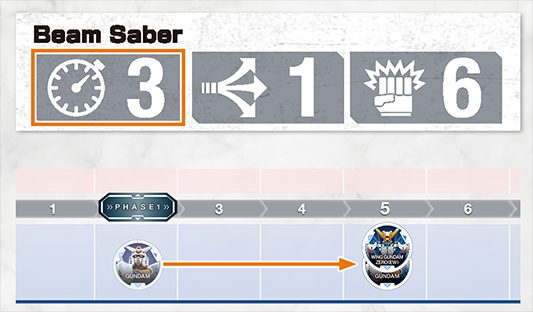
Range and line of sight
Every weapon prints a range. You may attack a target inside that range if the unit has clear line of sight. Terrain, other units and the scenario's own rules can block that line.
Targets are not only enemy units. Depending on the scenario, bases, carriers and garrisons are legal targets, and hitting an enemy garrison with even one damage destroys it for two VP.
Damage against hit points
Unit hit points run from 8 to 17 across the launch cards. At an average of 0.7 damage per die, killing a 15 HP unit with a three-dice weapon takes roughly seven attacks - and seven attacks is most of a Phase for one unit.
| Target HP | 2-dice attacks | 3-dice attacks | 4-dice attacks |
| 8 | ~6 | ~4 | ~3 |
| 12 | ~9 | ~6 | ~5 |
| 15 | ~11 | ~7 | ~6 |
| 17 | ~13 | ~9 | ~7 |
|---|
That table is the reason games are not won by attrition alone. Killing one unit is expensive in activations, so the units that pay for themselves are the ones that either hit harder than their cost or score VP without killing anything.
VP per hit point
Because every destroyed unit hands your opponent the VP printed on its card, durability and VP value together decide how attractive a target is. Dividing VP by hit points gives a rough "points given away per damage needed" figure:
- Wing Gundam Zero (EW): 9 VP over 12 HP - 0.75
- Unicorn Gundam (Destroy Mode): 10 over 14 - 0.71
- Gundam Aerial: 10 over 16 - 0.63
- Torohachi: 5 over 8 - 0.63
- Barbatos Lupus Rex: 10 over 17 - 0.59
- Char's Zaku II: 7 over 12 - 0.58
- Gundam Vidar: 7 over 13 - 0.54
- Guntank: 7 over 13 - 0.54
The full table for all fifteen cards is on the unit card database. The practical read: a Wing Zero is the most generous thing you can kill per point of damage, and a Vidar is the stingiest. Worth knowing when you decide what to shoot at.
Modifiers
- Status effects can raise or lower attack Strength, or increase the damage a unit takes.
- Energy is spent by stronger weapons and abilities; Energize is how you get it.
- Tactics cards can add dice, reroll, or change when an attack happens.
- Terrain and line of sight remove targets rather than modifying dice.
If you are coming from another miniatures game, the adjustment is mental rather than mathematical: there is no save to bail you out, so position and target selection carry the whole defensive burden. The unit actions page covers the attack sequence step by step, and the timeline page explains what each attack really costs.