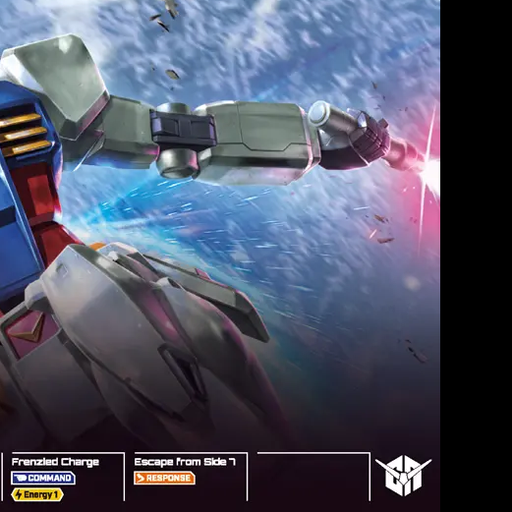
Nine Cards, Three in Hand
Each player brings nine tactics cards, shuffles them, draws three, and may play one per activation. A card can only be in your deck if at least one unit in your squad meets its requirement, and normally only one copy of each is allowed.
Tactics cards are the hand-management layer on top of the timeline. They are also the part of deck construction most new players get wrong, because the constraint is on your squad, not on the cards.
Deck, hand, draw
At the start of the game each player takes nine Tactics cards, shuffles them face down and draws three. Those three are your hand for Phase one.
At the end of Phase one, after the tenth round, each player draws three more. If you played three cards in Phase one you are back to six; if you played none you are holding six of your nine.
You may play at most one Tactics card per activation, and only during one of your own activations unless the card is a Response.
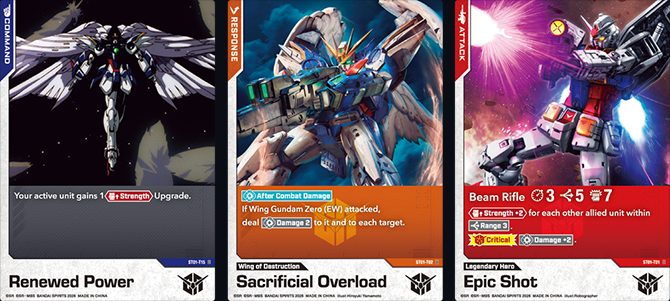
The three card types
| Type | When it can be played | What it usually does |
| Attack | During your attack, when the card's condition is met | Adds dice, rerolls, or changes damage |
| Command | During your activation, not mid-action unless stated | Moves units, grants an upgrade, shifts tempo |
| Response | As soon as its stated trigger occurs, whoever is acting | Interrupts, cancels, or answers an opponent |
|---|
Response cards are the reason you should not assume an attack is finished when the dice hit the table. A Response can be played as soon as its trigger happens, regardless of which player is currently activating or which action is being resolved.
The deck constraint that catches everyone
Your Tactics deck may include any card as long as at least one unit in your squad meets the requirement printed on it. Normally you may only include one copy of each card.
That means the deck is built backwards from your squad. If you take a card that wants a Londo Bell unit and your squad has none, the deck is illegal - and you will usually discover it when you try to play the card and cannot.
With the launch card pool this constraint is sharper than it looks. The faction traits printed across the fifteen unit cards are Earth Federation, Zeon, Gjallarhorn, Tekkadan, G Team, OZ, White Fang, Londo Bell, Civilian and Asticassia. A squad built entirely from one series will have access to a narrower slice of the card pool than a mixed squad, which is exactly the trade-off the deck rule is there to create.
Cards currently published
The official card list names the Tactics cards per set. The requirement line below each name on that list is the trait a unit must have.
| Card | Set | Requirement shown |
| Psycho-Frame Overload | EX01-T01 | Laplace's Guardian |
| Critical Rescue | EX01-T02 | Petite Mobile Suit |
| Swift Appropriation | EX01-T03 | Rapid Response |
| Full System Burn | EX01-T04 | - |
| On-Site Integration | EX01-T05 | - |
| Salvage Systems | EX01-T06 | - |
| Special OPs | EX01-T07 | Londo Bell |
| Target Reacquisition | EX01-T08 | Londo Bell |
| Grunt's Guard | T09 | - |
| Interference | PA01-T09 | - |
| Counter Attack | PA01-T08 | - |
|---|
Empty requirement cells mean the published list does not attach a trait line to that card. Always check the requirement printed on the physical card before adding it to a deck.
Playing them well
Three habits worth building early.
- Hold a Response for the attack that matters. Playing it on the first attack of the round usually wastes it.
- Do not spend the last card in hand for a marginal effect. Your hand refills once per Phase, at the end of Phase one, and nowhere else.
- Count the deck. Nine cards, three in hand, three more at the Phase break. If you have played four by the end of Phase one, you will be working from a five-card pool for the rest of the game.
Squad implications
Because the deck must be legal at setup, the squad building page and this page are really one decision. A squad with wide faction coverage buys access to more cards but spreads its traits thin; a focused squad gets less choice and more consistency. Neither is wrong, but the deck is where that choice shows up first.
If you are still assembling your first list, start from the unit card database and pick units with traits you can actually use, then build nine cards around them.