Setting Up Your First Game
Lay the map, place terrain and scenario tokens as the scenario sheet shows, put out the shared dice and energy piles, reveal squads, seed Timeline tokens at each card's starting value, shuffle nine tactics cards each and draw three, then start the round token on the lowest occupied round.
Setup in Gundam Assemble is mostly token placement, and it is where new groups lose the most time. The quick-start manual gives the order; this page turns it into a checklist you can run in about ten minutes.
Before anything: what comes out of the box
Starter Set 01 contains six unpainted miniatures, six unit cards, eighteen Tactics cards, one round token, two Scenario Objective cards, one game map, one sheet of paper terrain, a set of ten-sided dice, a handbook and two rule quick-reference tables.
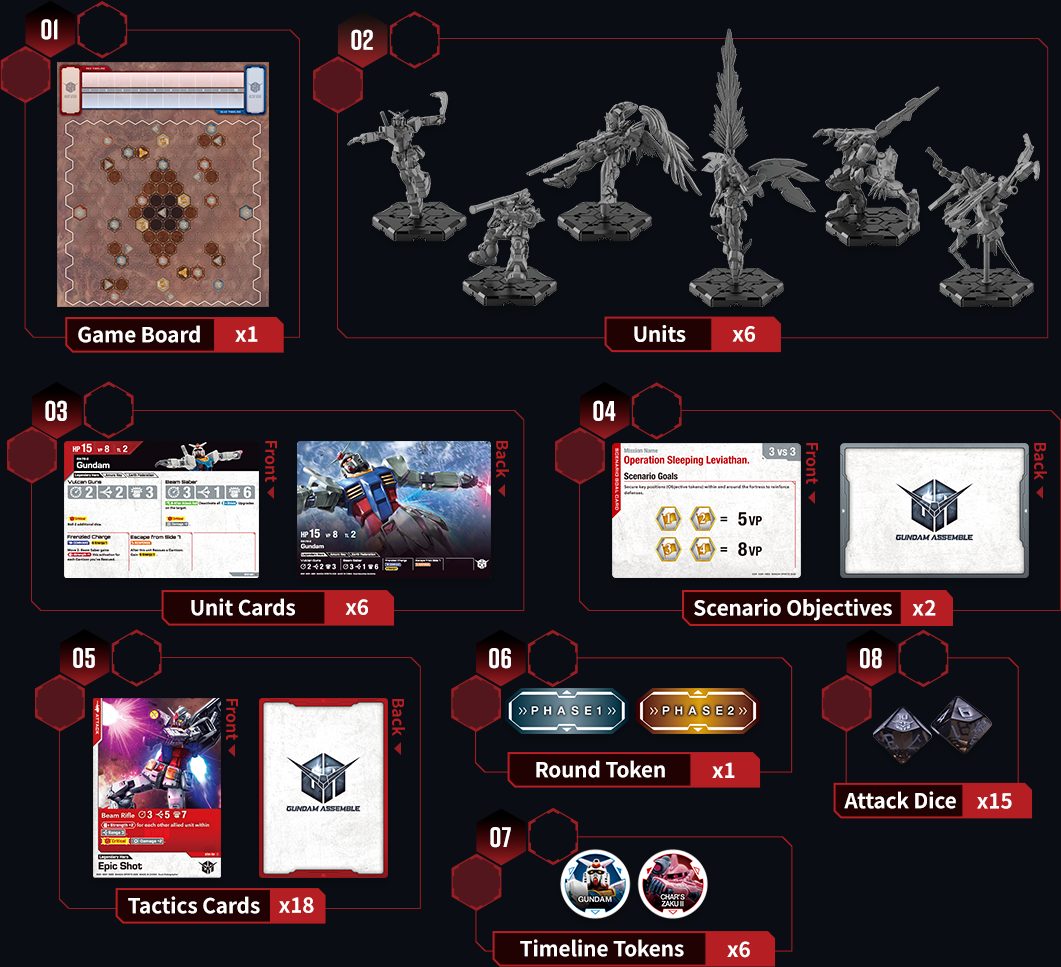
Playing a Deluxe set instead? You get thirteen miniatures and two maps, so the same steps apply with a larger footprint. Everything below assumes the starter set.
The seven steps
1. Put the map down. The game map goes in the centre of the play space. Leave a hand's width around each long edge for cards and dice; you will be reaching across it constantly.
2. Place scenario terrain and tokens. Follow the scenario sheet exactly: bases or carriers, garrisons, additional upgrades, energy, scenario objectives and terrain. These are not decorative. Garrisons are worth victory points and block movement, so a misplaced one changes the game.
3. Build the shared piles. Within reach of both players, put the spare upgrades, status effect tokens, energy tokens, attack dice, objective control tokens and any scenario-specific components. Everything both players may need should be reachable without standing up.
4. Pick sides and reveal squads. One player takes red, the other blue. Each reveals the squad they are using and lays out the matching unit cards face up in front of them. In a starter game the squads are the six miniatures in the box, split three and three.
5. Seed the Timeline. For each unit, put a Timeline token on your side of the track at the round printed as that card's starting Timeline value. If two of your units start on the same round, stack them in the order you want them to activate - you only get to choose this once, at setup.
6. Build the Tactics deck. Shuffle your nine Tactics cards, place the deck on your side of the table, and draw the top three. Those three are your hand for Phase one. Do not look through the deck while shuffling it.
7. Start the clock. Put the round token on the lowest numbered round that has a Timeline token on it, then begin with the unit whose token is on top of that stack. If both players have tokens on the same round, roll one attack die each; the higher roll activates first and ties are rerolled.
The token checklist
Most setup mistakes are missing tokens, not wrong tactics. Run this list before the first activation.
| Token | Where it goes | Why it matters |
| Timeline | Your side of the track, at each card's starting value | Sets activation order for the whole game |
| Round | Lowest occupied round of the track | Tells everyone whose activation is live |
| Energy | Shared pile, plus any scenario-placed energy | Spent by stronger weapons and abilities |
| Status effect | Shared pile, placed on cards during play | Tracks buffs and debuffs |
| Objective control | Shared pile, on objectives as they flip | Shows who scores at end of activation |
| Garrison | On the map, per scenario sheet | Two VP each to rescue or destroy |
|---|
Squad and deck notes
You may not exceed the number of units the scenario allows, and you cannot take two copies of a unit with the same card number unless it is Mass Produced. The squad building page covers that rule properly, including the one launch unit that is actually Mass Produced.
Your Tactics deck may include any card as long as at least one unit in your squad meets its requirement. A setup constraint, not a play constraint: you check it while building the deck, and a deck that fails it is illegal before the first round starts.
Table space and lighting
A starter-set game wants roughly 90 by 75 cm of flat table once cards and dice are out. You do not need a mat, but you do need a surface where a knocked token stays where it lands. If you are photographing games, light from above and slightly to one side; the models are small and detailed, and flat overhead light flattens them into silhouettes.
Common setup questions
Can I choose a different starting Timeline value? No. The value is printed on the card and is part of its balance.
Can I change the stacking order later? Not legally. You can only choose order when you place the initial tokens.
Do I place tokens for units that are not deployed yet? Every unit in your squad gets a token at setup; there is no reserve in the standard rules.
Once the table is set, the how to play page runs the first activation end to end, and the victory points page explains what you are actually playing for.