How a Round of Gundam Assemble Actually Runs
A round is not a turn. You activate one unit at a time in the order its Timeline token says, give it Advance plus any of the A-D action slots, then push its token forward by the timeline cost you paid. Ten rounds make a Phase; two Phases make a game.
If you have played a miniatures game before, the thing that will feel wrong for the first ten minutes is that there are no turns. There is a shared clock, and every unit sits somewhere on it. You do not move your whole army and hand over; you activate one unit, pay for what it did, and watch it slide down the queue.
The four action slots
Every activation gives a unit four kinds of action, labelled A to D on the reference card. You may use each slot once, in any order you like, but you must take exactly one Primary Action.
| Slot | Action | What it covers |
| A | Advance | Move up to three hexes in any direction |
| B | Primary Action | One of B-1 Attack, B-2 Dash, B-3 Energize, B-4 Rescue |
| C | Command Abilities | Any Command ability printed on the unit card, once |
| D | Tactics Card | One card from your hand, at most one per activation |
|---|
The Primary Action is the part that costs time. Attack, Dash, Energize and Rescue each advance the unit's Timeline token by a number of rounds, and that number is printed on the weapon or ability you used.
Advance is free, acting is not
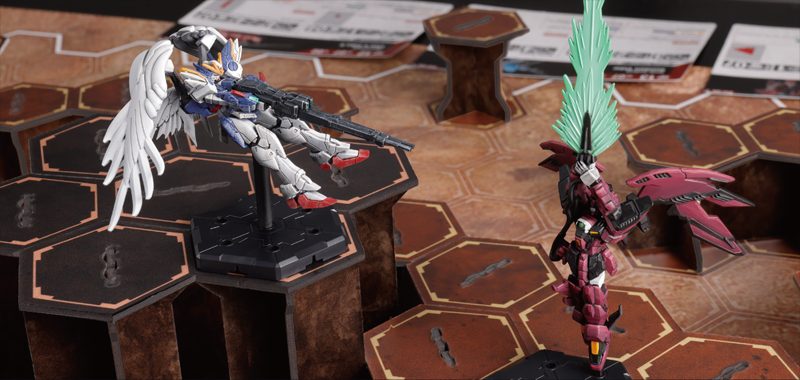
Advance moves a unit up to three hexes. It can travel in any direction, turn as it likes, and stop on any hex inside that distance. Terrain, enemy units and garrison tokens can block it; allied units can be passed through but not enemy ones, and only one unit may occupy a hex at the end of a move. Once a unit stops moving and takes another action, it cannot start moving again that activation.
Advance does not move the Timeline token. Attacking does. That single asymmetry is the whole economy of the game: positioning is cheap, damage costs rounds.
The timeline, in one paragraph
Each unit card prints a starting Timeline value. At setup you put that unit's Timeline token on that round of your side of the track. When a unit acts, its token moves forward by the timeline cost you paid. A unit cannot act again until the round counter reaches its token. Rounds with no tokens are skipped entirely, which is why a fast unit can act three times while a heavy one is still waiting for its second activation.
Attack, step by step
- Pick a weapon printed on the unit card.
- Move that unit's Timeline token forward by the weapon's timeline cost.
- Pick a target inside the weapon's range that the unit can see.
- Roll a number of attack dice equal to the weapon's Strength.
- Count every die showing 4 or higher as one hit; each hit removes one hit point.
- If any die shows 9 or 10, the attack is also a critical hit.
Critical hits resolve regardless of Accuracy modifiers and can trigger the weapon's critical effect. Some weapons need more than one critical to fire that effect, and unless the card says otherwise an effect triggers once per attack.
What a round actually looks like
Put the round token on the lowest numbered round that has tokens on it. If only one side has tokens there, that side activates. If both sides do, the quick-start manual gives two procedures: at setup, each player rolls one attack die and the higher roll activates first, rerolling ties; once the game is running, the round starts with the opponent of the player who acted last. Same-round tokens stack, and incoming tokens go underneath, so the order you set at deployment is the order you live with.
When a unit is destroyed, remove it and push its Timeline token two rounds forward. It will not act again, but the token still occupies the track and can matter for effects that count rounds.
Two phases, twenty rounds
Ten rounds make a Phase. At the end of Phase one the first Phase closes and Phase two begins. It is also when each player draws three more Tactics cards, taking a nine-card deck to a six-card hand if nothing has been played. The game ends at the end of Phase two, and most scenarios award the win to the highest VP total.
In practice, a starter-set 3v3 runs 45 to 90 minutes. See how long a game takes for the timings per box.
Your first turn, in order
- Put the round token on round one.
- Check which of your units has a token on that round.
- Activate it: Advance up to three hexes if you want the position.
- Take one Primary Action. If you attack, pay the weapon's timeline cost.
- Use a Command ability if it helps and you have not used one this activation.
- Play at most one Tactics card.
- Slide the unit's token forward by the costs you paid.
Run those steps once and you have played a full activation. Everything else in the rulebook is a modifier on that loop. If you want the token-level version of setup before your first game, the setup guide walks the table from flat to legal, and the timeline page explains why your heaviest unit feels like it is standing still.