Painting 50mm Miniatures
Wash the runner parts in warm soapy water, prime in thin coats, block in base colours, panel line with a fine tip or wash, then seal with a matte topcoat. Mask or scrape the ball joints so paint does not jam the pose.
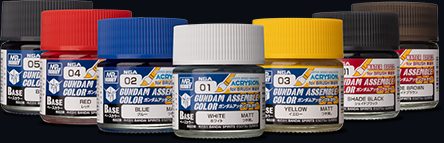
Gundam Assemble miniatures ship unpainted, and Bandai sells a paint line for them: Gundam Assemble Colors, a brush-on range with Base and Shade colours, plus the Mr. Brush BS series for detail work. A Paint Pack exists that bundles miniatures, a brush and four colours.
The order that protects the model
- Wash. Warm water with a drop of dish soap, five minutes, then air dry. Mould release and finger oil stop paint adhering.
- Prime. Thin coats, two light passes rather than one wet one. Spray or brush primer both work at this scale.
- Base colours. Block in the main areas. Two thin coats beat one thick coat every time.
- Panel line. A fine-tip liner or a thinned wash in the panel gaps.
- Details. Sensors, vents, weapon muzzles, eyes.
- Topcoat. Matte for a military look, satin if you want the plastic sheen back.
The wash step is the one people skip. On a 50 mm model, paint flaking off a shoulder in game three is almost always a primer adhesion failure, and it is avoidable.
Panel lining on a small model
Panel lines are the recessed grooves between armour panels. On a 50 mm figure they are shallow, so a wash works better than a pen in most places:
- Gloss topcoat first if you want the wash to flow and wipe cleanly.
- Apply the wash along the groove, not over the whole panel.
- Wipe across the surface with a clean brush or fingertip before it dries.
- Reapply for deeper lines rather than using a darker colour.
Panel lining alone, on bare plastic, is the highest-value 10 minutes per model in this hobby. It reads at table distance and it costs nothing but a liner.
Keeping paint out of the joints
Paint in a ball joint is the most common way to ruin a finished model. Mask shoulders, hips and ankles with a small piece of tape, or paint the limb before final assembly and scrape the peg clean afterwards.
If a joint does seize, do not force it. A drop of isopropyl alcohol on the joint, worked gently, will usually free acrylic paint.
Painting to tell squads apart
In a two-player game the models are the only thing distinguishing your three units from theirs at a glance. Three practical schemes:
- Shoulder and head only. Paint one shoulder and the head in a squad colour, leave the rest straight-build. Fast, readable, and easy to strip later.
- Full scheme. Base, shade, line and topcoat. Roughly 60 to 90 minutes per model at this scale.
- Wash and line only. A single wash over bare plastic plus panel lining. Twenty minutes per model and it looks deliberate.
The Paint Pack includes four Gundam Assemble Colors plus a brush, which is enough for the shoulder-and-head approach on a full starter set.
Avoid these
- Do not spray primer in cold or humid conditions. It fogs; at this scale fogging hides detail permanently.
- Do not use hardware-store enamel on bare polystyrene. It can craze the plastic.
- Do not varnish before panel lining. The wash needs a surface it can be wiped from.
- Do not paint the base of a snap-fit peg. It will not seat.
Time and cost
| Approach | Time per model | Extra cost |
| Straight build | 20 min | $0 |
| Panel line only | 30 min | ~$8 for a liner |
| Wash and line | 40 min | ~$20 for wash and liner |
| Full paint | 75-110 min | ~$40-60 for primer, colours, topcoat |
|---|
For a starter set of six, a full paint job is a weekend. The rules do not care either way - see unpainted minis - so paint at the pace that keeps you playing.