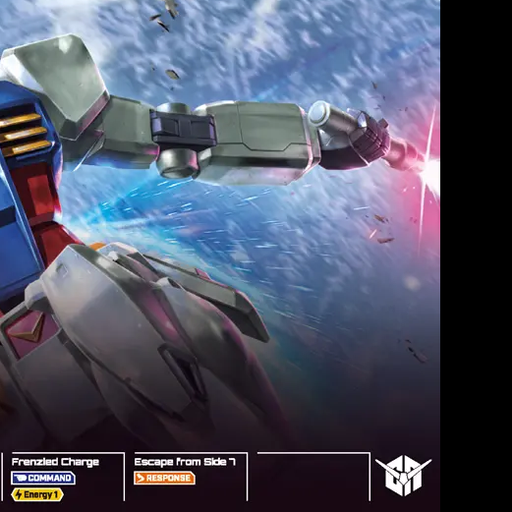
The Four Action Slots on Every Activation
Each activation gives a unit one Advance, exactly one Primary Action from B-1 to B-4, plus any Command abilities and one Tactics card. You may take them in any order, and each slot only once.
An activation gives you four slots and one obligation. You may use each slot once, in any order, and you must take exactly one Primary Action. Everything else - the movement, the command trick, the card - is optional.
The four slots
| Slot | Name | What it gives you | Timeline cost |
| A | Advance | Move up to three hexes, any direction | Free |
| B | Primary Action | One of Attack, Dash, Energize, Rescue | Printed on the weapon or ability |
| C | Command Abilities | Any Command ability on the unit card, once | Free |
| D | Tactics Card | One card from hand | Free |
|---|
The Primary Action is compulsory. If a unit activates, it must Attack, Dash, Energize or Rescue - you cannot simply walk and pass. That rule is what stops a game from becoming two players repositioning forever.
A: Advance
Advance moves up to three hexes. The unit may change facing as it likes, travel in any direction, and stop on any hex within that distance. It can move through hexes occupied by allied units but not enemy units, and it must end on a hex that contains only itself. Terrain, garrisons and scenario tokens can all restrict the route.
Two details that decide games: you may stop early, and once you take another action you may not resume moving. Advance does not move the Timeline token, so positioning is the one thing you get for free.
B-1: Attack
Pick a weapon, pay its timeline cost by advancing the unit's token, pick a target in range with line of sight, roll dice equal to the weapon's Strength, and score one hit per die showing 4 or higher. Any 9 or 10 is also a critical hit.
Targets are not limited to enemy units. Depending on the scenario, bases, carriers and garrisons can be attacked too, and destroying an enemy garrison is worth two VP. The full dice maths, including what a four-dice attack actually averages, is on the combat page.
B-2: Dash
Dash is the second Primary Action and the movement-focused one. One documentation note worth having before your first game: on the official quick-start page, the description block under the Dash heading repeats the Attack text word for word. The printed manual in the box is the authority for Dash; treat the web page's Dash paragraph as a copy-paste error rather than a rule.
B-3: Energize
Energize converts time into Energy. Spend two timeline - advance the unit's Timeline token two rounds - and place one Energy token on its card. A unit can hold several Energy at once.
Energy is what pays for the stronger weapons and abilities printed on cards. Because the cost is timeline rather than a separate resource pool, Energizing early is a real decision: you give up two rounds of relevance now for a bigger play later.
B-4: Rescue
Rescue is the garrison action. With an allied unit adjacent to a friendly garrison token, spend two timeline as your Primary Action, remove the garrison from the board and score two victory points.
Same value as destroying an enemy garrison, which only requires dealing one or more damage to it. Rescuing is the safer play; destroying is the aggressive one. Both are two VP, and both remove the token from the board.
C: Command abilities
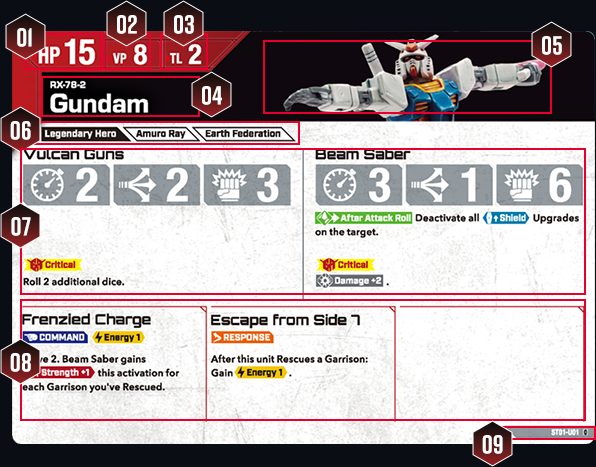
Command abilities are the ones printed on the unit card and marked Command. Each may be used once during that unit's activation, and not in the middle of another action unless the card says otherwise.
This is where most of a unit's character lives. A Command ability that pushes a unit two hexes or rerolls a die is usually worth more than the one point of damage you gave up by not attacking with something else.
D: Tactics cards
You may play at most one Tactics card per activation. Cards come in three types - Attack, Command and Response - and each type says when it can be played. Response cards, for example, are played in reaction to a stated trigger regardless of whose activation it is.
Deck construction is on the tactics card page. The play restriction here is simple: one per activation, not one per round.
Status effects
Some abilities apply statuses. Beneficial ones can raise movement or attack Strength, harmful ones can increase damage taken or force a unit to move zero hexes on its next Advance. Statuses are tracked with tokens on the unit card, and they persist as long as their source says they do.
Ordering your activation
The most common beginner mistake is taking the Primary Action first because it is the loudest option. Against a unit that is already in range, attacking first is correct. Against a unit out of position, Advance first, then attack from the better hex; the Advance is free, and the attack costs the same timeline either way.
The second most common mistake is spending a Command ability in the middle of an attack. Unless the card explicitly allows it, wait until the attack resolves.
Once you are comfortable with the four slots, the timeline page is the next thing to read: it explains why the same activation can come back in three rounds or in eight.